
 By The Metro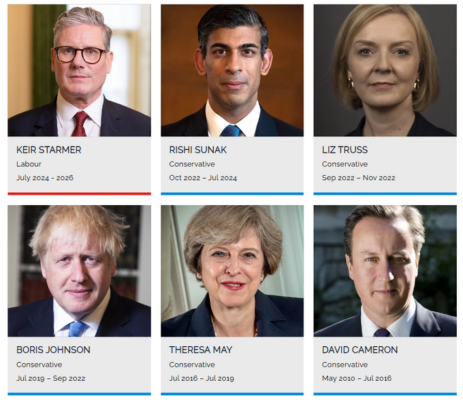
The United Kingdom has witnessed one of the most politically unstable periods in its recent history, with six prime ministers taking charge of the country within a decade. The frequent changes in leadership have reflected deep divisions over national issues, internal party disputes and major political shifts that transformed both the Conservative and Labour parties.
The period began with David Cameron’s resignation after the 2016 Brexit referendum and continued through Theresa May’s difficult Brexit negotiations, Boris Johnson’s turbulent administration, Liz Truss’s brief tenure, Rishi Sunak’s efforts to restore economic confidence and Keir Starmer’s leadership of a Labour government.
Each administration faced major national challenges, including Brexit, the COVID-19 pandemic, rising living costs and economic uncertainty. Starmer’s resignation has now added another chapter to Britain’s recent political instability, with the process of selecting his successor expected to shape the country’s next political direction.
1. David Cameron (2010 – 2016)
David Cameron became Prime Minister in 2010 after forming a coalition government between the Conservative Party and the Liberal Democrats. Following the 2015 general election, he continued as leader of a Conservative majority government.
His time in office was largely defined by austerity measures aimed at reducing the national deficit after the global financial crisis. However, his premiership became most closely associated with the 2016 Brexit referendum.
Cameron called the referendum and campaigned for the UK to remain in the European Union. After the Leave campaign secured victory, he announced his resignation, saying new leadership was required to oversee the country’s next phase.
2. Theresa May (2016 – 2019)
Theresa May succeeded Cameron in 2016, taking office during one of the most challenging periods in modern British politics. Her government was dominated by efforts to negotiate the UK’s withdrawal agreement with the European Union.
Despite reaching a deal with the EU, May repeatedly struggled to secure approval from Parliament. The repeated defeats weakened her authority and increased pressure from within the Conservative Party.
In 2019, May announced her resignation, bringing an end to a premiership largely defined by the difficulties of delivering Brexit.
3. Boris Johnson (2019 – 2022)
Boris Johnson became Prime Minister in 2019 after winning the Conservative Party leadership contest. His campaign centred on the promise to “get Brexit done”, and his government completed the UK’s formal departure from the European Union in January 2020.
His administration was also shaped by the COVID-19 pandemic, which brought major public health and economic challenges.
However, Johnson’s leadership was damaged by several controversies, including the Partygate scandal and growing criticism from within his own party. After losing support among Conservative lawmakers, he resigned in 2022.
4. Liz Truss (2022)
Liz Truss became Prime Minister in September 2022 after winning the Conservative leadership election. Her government faced immediate economic challenges following the announcement of a controversial mini-budget.
The financial plans triggered market instability and increased pressure on her administration. With political support rapidly declining, Truss resigned after only 45 days in office.
Her tenure became the shortest of any British prime minister in history.
5. Rishi Sunak (2022 – 2024)
Rishi Sunak replaced Liz Truss in October 2022 with a mission to restore economic stability and rebuild confidence in government.
His administration focused on reducing inflation, maintaining financial discipline and addressing challenges affecting public services. However, his government continued to face difficulties, including immigration debates, industrial action and the wider cost-of-living crisis.
Sunak remained Prime Minister until the 2024 general election, when the Conservative Party suffered defeat, ending 14 years of Conservative-led governments.
6. Keir Starmer (2024 – 2026)
Keir Starmer became Prime Minister in 2024 after leading the Labour Party to a decisive general election victory, marking the end of Conservative rule.
His government promised to rebuild public services, introduce economic reforms and restore public confidence in political institutions.
Starmer’s leadership represented a shift towards Labour’s approach to governance after years of Conservative administrations.
However, his resignation in 2026 created another leadership transition, continuing a decade-long pattern of political change in Britain. A successor is expected to be chosen, marking another leadership transition in the United Kingdom.