
 By The Metro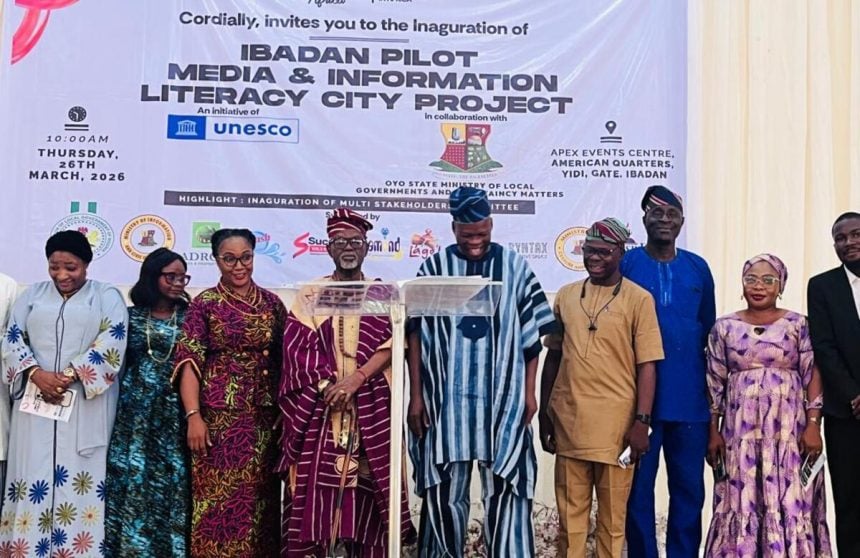
The United Nations Educational, Scientific, and Cultural Organisation (UNESCO) has explained how Ibadan fits into the pilot Media and Information Literacy (MIL) city project in Nigeria and across Africa.
During the launch of the MIL city project in Ibadan on Thursday, the organisation said that Ibadan stands as a historical pioneer of media and education spaces, always setting the pace by placing learning at the centre of everyday life.
The pilot Ibadan MIL city project is hosted by the Centre for Applied Ethics and Political Communication in Africa (CAEPOCOM Africa), in collaboration with the Oyo State Ministry of Local Government and Chieftaincy Matters, major media houses, and other relevant organisations in the city.
Head of office and representative at UNESCO in Abuja, Dr Jean-Paul Ngome Abiaga, represented by Dr Sharon Omotoso, decried how false information deepens division, fuels tension, and erodes trust with dire consequences to people and society, which is why the Ibadan MIL city project is germane in these times.
The UNESCO representative said that in a diverse and dynamic country like Nigeria, fake news and misinformation are not merely a technological challenge, but also a social one that threatens unity and democracy.
UNESCO said that the Ibadan Pilot MIL city project is a call to action to build a Nigeria where news and information empower rather than divide, stressing, “Building trust and strengthening our information ecosystem is a shared responsibility.”
In light of this, UNESCO said the initiative is for everyone, and the vision requires the collective effort of the government, media professionals, civil societies, educators, students, among other people and organisations.
Delivering the opening remarks, the coordinator of CAEPOCOM Africa, Oyebanke Oyelaja-Kayode, stated that, though Ibadan is rich in history and cultural heritage, it is confronted with the spread of misinformation, disinformation, and fake news, as in other major cities across the world.
Oyelaja-Kayode further stated that, with the Ibadan MIL city project, they will work with UNESCO and other stakeholders in the city to build a society where information is not just accessible, but accurate, reliable, and empowering.
For the project, she said they will train government and civil servants on media matters, visit grassroots communities and public places, and organise capacity-building workshops for students and content creators.
Oyelaja-Kayode said the initiative is for everyone, and therefore, needs the support of everyone to address fake news, hate speech and disinformation in Ibadan and Nigeria.
The chairman of the occasion, who also represented the Olubadan of Ibadanland, Chief Lekan Alabi, noted that Ibadan is first in media establishment and endeavours, which was why the establishment of the city for the MIL city project was not a happenstance, but an honour it deserved.
Alabi stressed that the project is timely because true news and information, which are lacking these days, help to build peace and harmony in society. He advised that whatever anyone writes or says should be fair to all.
In light of this, he urged UNESCO and its partners on the project to keep to their promises and ensure that the project is sustained for the public good.
The Oyo State Commissioner for Culture and Tourism, Wasiu Olatunbosun, spoke on the relevance of the project and how it will help address fake news and misinformation in Ibadan. He pledged the Ministry’s support for the project and urged everyone to key into it.
A highlight at the event was the inauguration of the project’s Stakeholders’ Committee, which comprises key stakeholders in the city, including government ministries and agencies, major media organisations, schools and civil societies, the security sector, religious and socio-cultural organisation, among others.
Tribune Online